Sunday, December 11, 2022

Dardanos-Scythian-King-versus-Tart-Turkic-root


Dardanos was a Scythian king. 

It reminds me of Turkic root dart-/tart- meaning to pull, to hang and further to throw (a speer, a slingshot ), acc. to Eyuboglu. 

Acc. to Gülensoy tart- means "to swing the reins of mounts".

This root derives from tar- "to rough up".


It is a very old Proto Turkic verb meaning initially to pull, to hang. 

*


Uzunbacak Adem

Saturday, December 10, 2022

Lynkos-2-mountains-and-a-Scythian-king


Lyncus

From Wikipedia, the free encyclopedia
Jump to navigationJump to search

In Greek mythology, King Lyncus ([ˈ] Greek: Λύγκος, pronounced [ˈlyŋkos]) of the Scythians was taught the arts of agriculture by Triptolemus but he refused to teach it to his people and then tried to kill Triptolemus. Demeter turned him into a lynx as punishment.[1]


*


Lynkos/Lyncus is a King who taught the arts of agriculture. 

There are two mountains called Lynkos, too.


*


There is a Turkic root ALANG (alaŋ) meaning level ground/plain. Could it be related to these 3 names? King Lynkos (because he taught the art of agriculture on the plains?) and Lynkos mountains have plains?


((A)LUNGOS>LYNKOS?))


*


*


Uzunbacak Adem 

2-scythian-deities-tabiti-tamimasadas-Turkic-roots


Tabiti or Tapati, a Scythian goddess. 

The western scholars think that the root must be Indo European:

wiki: ...


and was related to the Avestan term tāpaiieⁱti (𐬙𐬁𐬞𐬀𐬌𐬌𐬈𐬌𐬙𐬌‎) meaning "to warm," Latin tepeo and several other Indo-European terms for heat, as well as to the similar name of the Hindu goddess Tapatī (तपती) and to the verb related to the latter's name, tapayati (तापयति), meaning "burns" and "is hot."[10] and to the Sanskrit term tápas (तपस्), which denoted the cosmic warmth and the original nature, that is the cosmic principle out of which originated the multiple elements of the Universe and the order in the world....


*


There is a Turkic root tap meaning simply "to worship, to wish and to pray".


Could it be related to it, too?


*


the 2nd one Thamimasades


*


There is a PTurk.root  *Tạm- meaning 1 to burn (tr.) 2 to kindle 3 to become excited.

-mas/-maz: suffix for "not" Ata: the father

> Godfather who doesn't burn? Tammazata?


*

It could be related to Tabiti in this sense. Did Herodotus muddle up these two deities?

Sources: Thamimasadas and Tabiti

+

Uzunbacak Adem

Turkic-balik-Greek-polis

Drum Tower - Khanbaliq - Peking


Bakın bakın!

ProtoTurkic bialık: city, fortress
>Turkic Balık city 
(for example Hanbalık (City of Khan) = Today's Peking/Beijing)
Hungarian falu (pl. faluk): village
Mongolian Balağasun: city, fortress
ProtoTunguz palVga: a group of houses
Old Greek póli-s: city, fortress
Lithuanian pilis: fortress Latvian pils: fortress İlginç mi?
Interesting?

*


*


UZUNBACAK ADEM


Scythian-Kingnames-Argunt-Gnur-Luk-are-Turkic-names


Kurgan stelae of a Scythian at Khortytsia, Ukraine

*

Birkaç yeni İskit başbuğ adı:

Argunt Eski Türkçe Arkun: melez at; VEYA Yargun: memeli hayvan (örnek öküz veya ayı)1-2 Gnur Eski Türkçe kongur/konur: kahverengi (Atının donu?)3 Luk/Lū̆ka (Lykos) Eski Türkçe ulug/uluğ


* (Pauly'de İskit adı geçen maddelere bakıyorum şu ara).
Şu görseldeki adlara bak. Octamasades Agaros Palacus Tanusakos Sariakos * Atilla’nım Babası Muncuk (Boncuk)

source wiki : the names of the Scythian Kings

Alayının Türkçe olmaması için hiçbir neden yok. Bunlar ilk bakışta göze çarpıp, burdayım diyenler. 

*

ENGLISH VERSION

A few new Scythian chieftain names:
 
Argunt Old Turkish Arkun: hybrid horse  OR Yargun: mammal (quadruped animal)

 Gnur Old Turkish kongur/konur: brown (The color of his horse?) 

Luk/Lū̆ka (Lykos) Old Turkish ulug (great, holy) 

* 

(I'm looking at the items called Scythian in Pauly at the moment). 


Look at the names in this image. 
Octamasades 
Agaros 
Palacus 
Tanusakos 
Sariakos * 
Atilla's Father Muncuk (Turkic Boncuk >Beads)

 There is no reason why this names on this list should not be Turkish. These are those who catch the eye at first glance.

(for the pics dealing with this English version, look above)
*


Uzunbacak Adem

Sunday, December 4, 2022

new-List-of-Pre-Greek-words-versus-Turkic-words


Hier ist the list!
Enjoy.


Pre-Greek

Meaning

Info

Turkic

Meaning

Info

Sisura

cloak made of goat's hair (Scythian)

Σισύρα

PTurk. *sɨd- 1 skirt, lap 2 to tuck up (sleeves, skirts) (1 пола, подол 2 подворачивать (рукава, полы)): Karakh. sɨδɨɣ 1, sɨtɣa- 2 (MK); Tur. siɣ, sij, siji (dial.) 1, sa-, dial. sɨɣa- 2; Gag. suva-, sua- 2; Turkm. sɨj 1; Tat. sɨjɨr- 2 (dial.); Khak. sɨzɨm ‘band on a shaman’s beater’; Chuv. šъraś ‘tas- sel (on the end of belt); coating (on skirt edges) 


sicim: a kind of rope

compare> PROTO ALTAIC: *sísu ( ~ z-) to baste, cloth: Tung. *sise-; Mong. *sisegej; Jpn. *súsuá; Kor. *sɨs-. 


ψύγω (psúgō)

breath, blow chill, make cold


Altaic Buskan: snow storm

bus, pus: ice

bugu: mist, vapor

σιηγών (siēgṓn)

jaw, jawbone


çenge, çanga

jawbone


ψόλος/ἄσβολος

soot, smoke


is, pus, bus

soot, smoke, vapor


ἐνεός

dumb, mute


Proto-Altaic:*ēŋV: to think, understand

Turkic: *āŋ, *āŋ-la- to understand


κάρταλος(kártalos)

a basket


PTurk. *KAdɨr- to twist, turn, 


Uyghur: qari-, qajrɛ-; 


korwa

girl

Mycanean Greek 𐀒𐀷 (ko-wa /kórwā/) f

KIR 

girl

Mongolian gergei: wife

μύκλος

fold on the donkey's neck


bük-

to bow, bend, to curve, bend, wrap smth. 


τόπος

place, location, topic, (rhetoric) common place


PTurk. *top all, completely; complex, collection 


topla-: to get toegther


τύλη

swelling, callus

hump of a camel

PTurk. *dōl- full 


OLD Turkish tolu: full


τάγχουρος

gold


KIR>KIZIL

red, reddish, 

kùruá ‘black’ (having a different accent). It is interesting to note metal names derived from this root: Turk. *Kɨŕɨl ‘gold’ (see Лексика 403-404) = Mong. kürel ‘bronze’ = Kor. kùrí ‘copper’. 


Ὄλυμπος

Olympos mountain 

Alternative: Οὔλυμπος(Oúlumpos) <Oru?

oru

high place

by Oulumpus: Ulu? (great)

Κύπρος

Cyprus island


from Copper?

Turkic Bakar/BAKIR

Bakar ~ Beaker (German Becher)


*


Uzunbacak Adem


Saturday, December 3, 2022

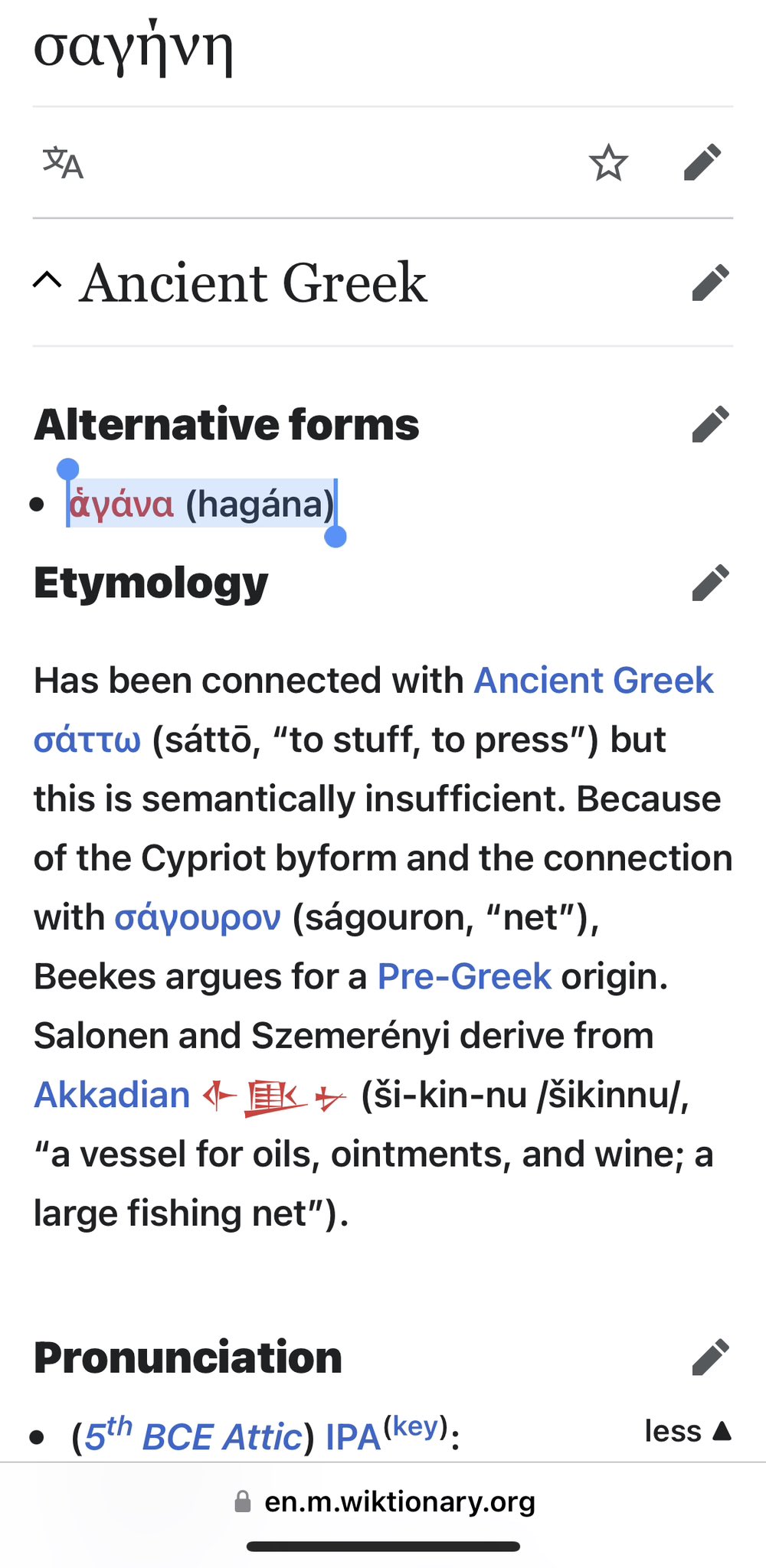
PreGreek-sagini-Cypriote-hagana-ProtoAltaic-agna


Trüf domuzu işbaşında:

Yunanca σαγήνη (sagini) (S-mobile?) avlanmaya yarayan ağ demek Kıbrısçası ἁγάνα (hagána) Kelime kökeni bilinmiyor. Şimdi aşağıdaki Proto Altayca sözcüğü bakın: *àgŋa (Kıbrısça ἁγάνα ile karşılaştır) Türkçe ağ anlamında (ör- eylemi anlamı da var)/4 Birbiriyle ilişkisi olmadığına inanalım mı?

*

Truffle pig at work: 

Greek σαγήνη (sagini) means a net for hunting.(S-mobile?)
Cypriot version ἁγάνα (hagána).
The origin of the word is unknown. 

 Now look at the Proto Altaic word below: 

 *àgŋa (See ἁγάνα above)

means network in Turkish (e.g. also has the meaning of the verb to spin)

 Shall we believe that they are not related to each other?

*


*

UZUNBACAK ADEM

Turkish-Alev-Sumerian-Zal-Zalag-Hungarian-Csillag


Kısa sözcük, uzun tweet.

ALEV
Sizce Türkçe mi? Eren Farsça, der Eyuboğlu Türkçe Gülensoy incelemez Nişanyan Türkçe>Farsça der.
Ben de Sümerce zal (to shine) ve zalag'ı (radiant) yanına koyayım, bir de Macarca csillag (yıldız).
Soru:

Proto-Altaic: *zi̯oĺa' (to shine) uyar mı yanlarına?

*

Short word, long tweet. 

 ALEV (FLAME)

Do you think it is Turkish? 

Eren says Persian
Eyuboglu Turkish 
Gülensoy does not review 
Nişanyan says Turkish>Persian. 

 Let me put the Sumerian zal (to shine) and zalag (radiant) next to it, and the Hungarian csillag (star). 

 Question: 

Proto-Altaic: Could *zi̯oĺa' (to shine) suit them?

*


*

UZUNBACAK ADEM

Goddess-Gaia-versus-Tuerkic-Kaya

Gaia /  Γαῖα (pic: wiki)  Gaia  is the personification of  Earth in Greek mythology and  its etymology according to wiktionary: The Greek na...